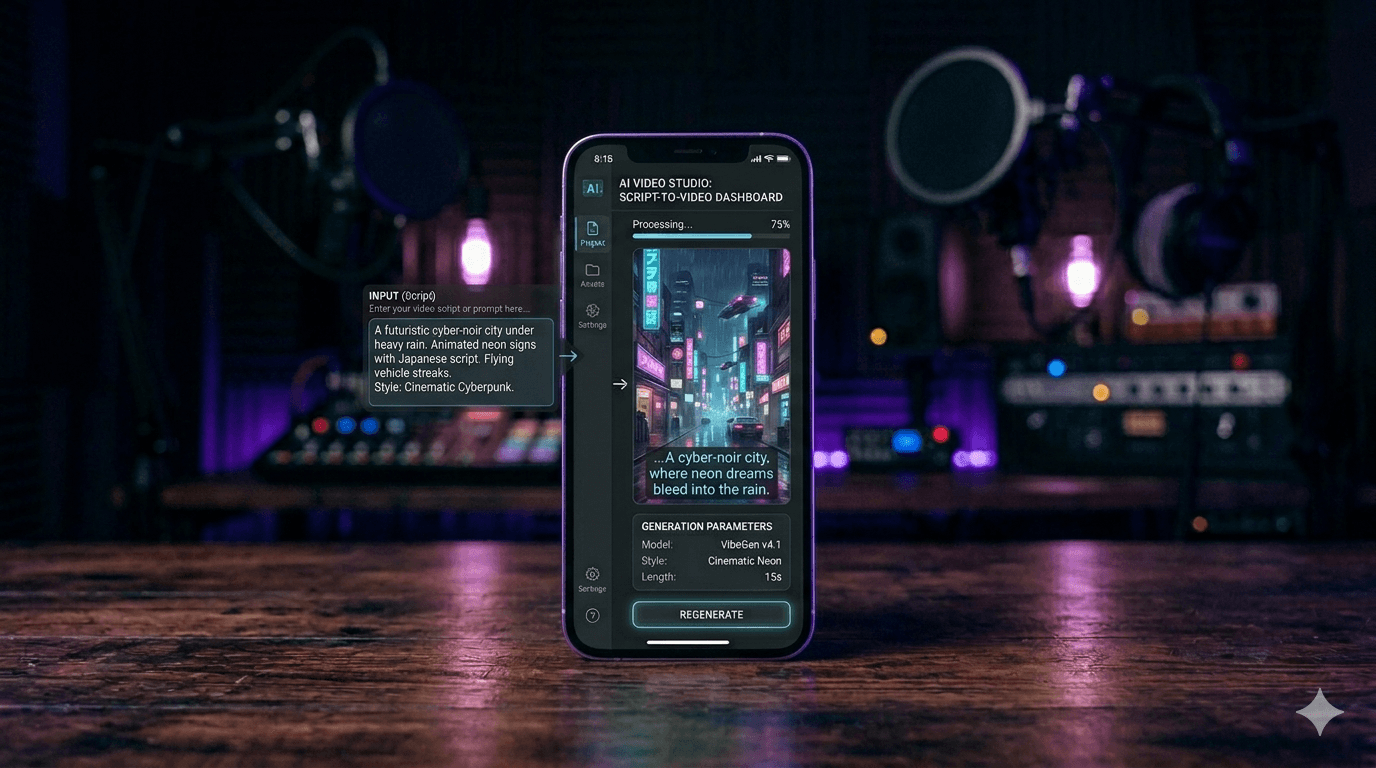
YouTube Shorts hit 200 billion daily views in 2025 — announced by YouTube's own CEO at Cannes Lions (Search Engine Journal, June 2025). And a huge share of that audience watches content from creators who never once showed their face.
Faceless video isn't a loophole. It's a strategy. The creators using it are publishing more often, burning out less, and scaling faster than those who rely on being on camera every day.
This guide breaks down exactly what faceless video is, which niches work best, and how to build a workflow that lets you create short-form content in under 10 minutes — with or without technical skills.
Key Takeaways
- YouTube Shorts reaches 200 billion daily views (YouTube CEO, 2025). Faceless creators capture this audience without ever appearing on camera.
- Short-form video posts grew 70% in 2025 alone (Metricool, Sept. 2025).
- AI tools can reduce video production costs by up to 91% vs. traditional methods (Zebracat AI, 2025).
- The full faceless video workflow — script, voice, visuals, captions — takes under 10 minutes with AI.
What Is a Faceless Video?
A faceless video is any video where the creator never appears on screen. Goldman Sachs estimates that 50 million people globally now identify as content creators (Goldman Sachs, 2025) — and a growing segment of them are building entire channels without a camera, a ring light, or even a microphone.
The format typically uses one of three approaches:
- AI voiceover + animated visuals — A script is read by a synthetic voice while images or short clips play on screen. This is the most common format for short-form creators.
- Text on screen — Captions drive the narrative without any narration at all. Think finance tips, quick facts, motivational quotes.
- Screen recordings or slideshows — Tutorial-style content that shows a process without showing the person doing it.
Channels built entirely on faceless content span dozens of niches: personal finance, history, true crime, productivity, news summaries, AI tools. None of them require the creator to be on camera.
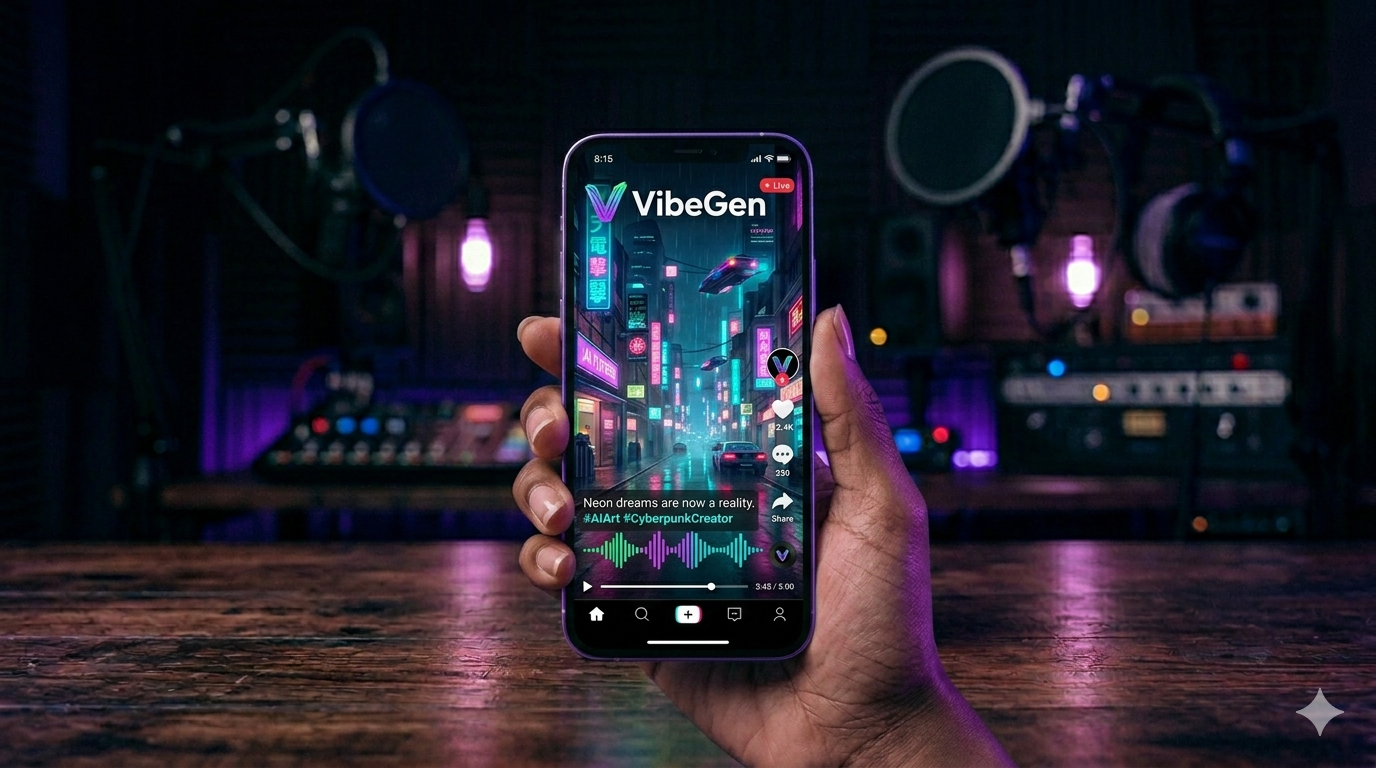
Why Do Faceless Videos Perform So Well on Short-Form Platforms?
63% of consumers say they prefer short-form video to learn about a product or service (Wyzowl, 2026). That preference doesn't change based on whether a face appears — what matters is clarity, pacing, and whether the content holds attention in the first two seconds.
Faceless videos have a structural advantage here. Without a person on screen, the visual must carry the message. That forces tighter editing, better hooks, and more deliberate content decisions.
Three reasons faceless videos specifically thrive on short-form platforms:
1. No setup friction. There's no lighting rig to arrange, no background to clean, no makeup to apply. You can record a script, generate visuals, and publish — from anywhere, in any condition.
2. Faster publishing cadence. Creators who show up on camera often hit burnout at 3-4 videos per week. Faceless workflows scale to 5-7 without the same personal cost.
3. Platform-agnostic. The same content can be reformatted for TikTok, Reels, and Shorts without re-filming anything.
Short-form video posts grew 70% in 2025, based on analysis of over 5 million videos across 582,000 accounts (Metricool, September 2025). The platforms are rewarding frequency, and faceless workflows are built for it.
Faceless short-form video combines two of the strongest signals platforms reward — consistent publishing cadence and high watch time — without requiring personal exposure. Creators using AI-generated visuals and voiceover can publish daily without the burnout associated with on-camera content, according to platform usage data from Metricool's 2025 short-form video report.
Which Niches Work Best for Faceless Short-Form Videos?
91% of businesses use video as a marketing tool in 2026 (Wyzowl, 2026) — but the individual creator opportunity is even wider. Not every niche suits faceless video equally well. These six consistently outperform the rest:
-
Quick facts and listicles — "5 things you didn't know about X" performs extremely well in under 45 seconds. The format is repeatable and doesn't require original research.
-
Personal finance basics — Budgeting, investing terminology, credit scores. High value, evergreen, and audiences engage heavily with financial content.
-
Productivity and life tips — Actionable advice people can implement immediately. Short format works perfectly because each tip stands alone.
-
Motivational content — Quote videos, mindset clips, transformation stories. Low production cost, high share rate.
-
News and trend summaries — Summarizing what's happening in a niche. Time-sensitive but highly searchable.
-
AI tools and tutorials — One of the fastest-growing categories. Creators who explain how to use AI tools are capturing massive demand with zero camera time.
For a full breakdown of each niche's CPM, competition level, and realistic monthly earnings, see our guide to top faceless YouTube niches ranked by revenue.
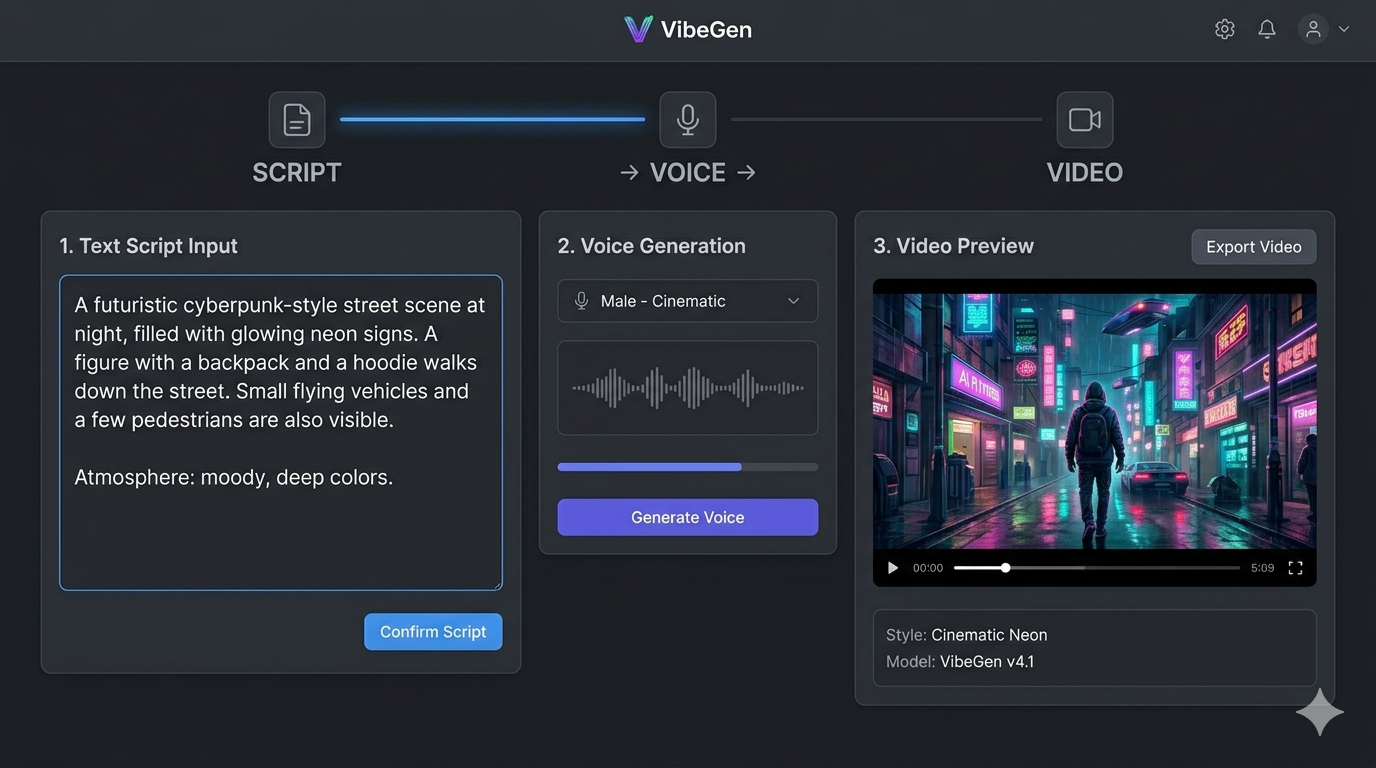
How to Create a Faceless Video with AI — Step by Step
Creating a faceless video manually — script, voiceover recording, video editing, captioning — takes 2 to 4 hours. With AI, the same output takes under 10 minutes. The core workflow has six steps.
Step 1: Pick One Idea (Not Five)
The most common mistake in short-form video is trying to cover too much. One idea, one video. Your hook should communicate that idea in the first two seconds — before someone swipes away.
Ask: "Can I summarize this in one sentence?" If not, split it.
Step 2: Write a 60-Second Script
Short-form scripts run 120–180 words for a 60-second video. Structure it as: hook → body (3 points max) → CTA.
Write the way people talk. Contractions, short sentences, no jargon. The script is the backbone of everything that follows.
Step 3: Generate the Voiceover
AI voiceover tools produce natural-sounding narration from text in seconds. Pick a voice that matches your niche's tone — authoritative for finance, warm for wellness, energetic for productivity.
The voice should feel consistent across every video you publish. Consistency builds recognition even without a face.
Step 4: Create the Visuals
This is where most creators get stuck. There are three approaches, ordered by cost-effectiveness:
- Ken Burns effect on AI-generated images — Still images animated with slow zoom/pan. Looks professional, costs almost nothing, and works perfectly for most niches. See our full photo-to-video AI workflow guide for a step-by-step breakdown of this approach.
- Short video clips — Relevant b-roll matched to the script. Higher visual quality, more complex to source.
- AI-generated video — The most premium output. Moving scenes generated from text prompts.
For most creators starting out, Ken Burns + AI images is the right call. It's fast, cheap, and gets out of the way of the content.
Step 5: Add Auto-Captions
85% of social media videos are watched without sound. Captions aren't optional — they're the difference between a view and a skip.
Auto-captions generated from your script are accurate enough for most content. Spot-check them before publishing.
Step 6: Publish and Track
Post at the same time each day your channel is active. Check watch time and average percentage viewed after 48 hours. If people are dropping off in the first 5 seconds, your hook isn't working.
How Do You Scale to 5 Faceless Videos Per Week?
Publishing 5 videos per week manually isn't sustainable. The creator economy is worth $250 billion today and projected to reach $480 billion by 2027 (Goldman Sachs, 2025) — but that growth belongs to creators who build repeatable systems, not one-off viral attempts.
Scale comes from treating your channel as a production pipeline, not a creative project.
Three habits that separate creators publishing 5x/week from those stuck at 1x/week:
Batch your scripts. Write five scripts in one sitting, once a week. Script-writing is a cognitive task. Batching it reduces the mental switching cost.
Templatize your visuals. Use the same visual style, same animation speed, same caption font for every video. Consistency reduces production decisions to near zero.
Automate the repetitive steps. Script to voiceover to visuals to captions — this entire chain can be automated with AI tools like ShortOpus, which handles each step in a single workflow without switching between apps.
The creator economy's growth from $250 billion to a projected $480 billion by 2027 will be driven by creators who publish at scale, not creators who publish perfectly. Goldman Sachs research (2025) shows the total number of global creators growing from 50 million today to 107 million by 2030 — the opportunity is wide open for faceless content producers.
What Mistakes Kill Faceless Channels Before They Start?
Most faceless channels that fail do so for predictable reasons. Here's what to avoid:
Frequently Asked Questions
What is a faceless video?
A faceless video is content where the creator never appears on screen. Instead, it uses AI voiceover, animated images, text overlays, or stock footage. Popular on TikTok, YouTube Shorts, and Instagram Reels, it lets creators publish consistently without camera equipment or personal exposure.
Can you make money with faceless YouTube videos?
Yes — faceless channels monetize through AdSense, brand sponsorships, and affiliate marketing. YouTube's requirements are the same for all channels: 1,000 subscribers plus either 4,000 watch hours or 10 million Shorts views in 12 months. Finance and productivity niches tend to attract higher CPM advertisers.
How do I start a faceless YouTube channel with AI?
Pick one niche and build a repeatable workflow: write a 60-second script → generate an AI voiceover → create animated visuals → add auto-captions → publish. Aim for at least 3 videos per week for the first 90 days. An integrated AI tool removes technical bottlenecks so you can focus on content ideation.
What are the best niches for faceless videos?
The highest-performing niches are personal finance (high CPM, strong evergreen demand), productivity tips (highly shareable), AI tools and tutorials (fastest-growing in 2025–2026), and motivational content (low production cost, high engagement). All work without on-camera presence and scale well with AI-generated visuals.
Do faceless channels get monetized on YouTube?
Yes. YouTube's Partner Program applies equally to all channels: 1,000 subscribers plus 4,000 watch hours, or 10 million Shorts views within 12 months. The one requirement is original content — original narration and visuals matter even in a faceless format, per YouTube's reused content policy.
What to Do Next
Faceless video is one of the most scalable content strategies available to solo creators right now. The barrier isn't technical — it's commitment to a consistent workflow.
- Pick one niche and write your first five scripts this week
- Build a repeatable production workflow (script → voice → visuals → captions)
- Publish at minimum 3 times per week for 90 days before evaluating
The creators who win at faceless content aren't the most creative ones. They're the most consistent ones. To automate the full channel pipeline - scripting, voiceover, publishing, and scheduling - see our complete faceless YouTube automation guide. If you're evaluating which editing or AI video tool to use, our CapCut alternatives guide breaks down the best options by use case and cost.